



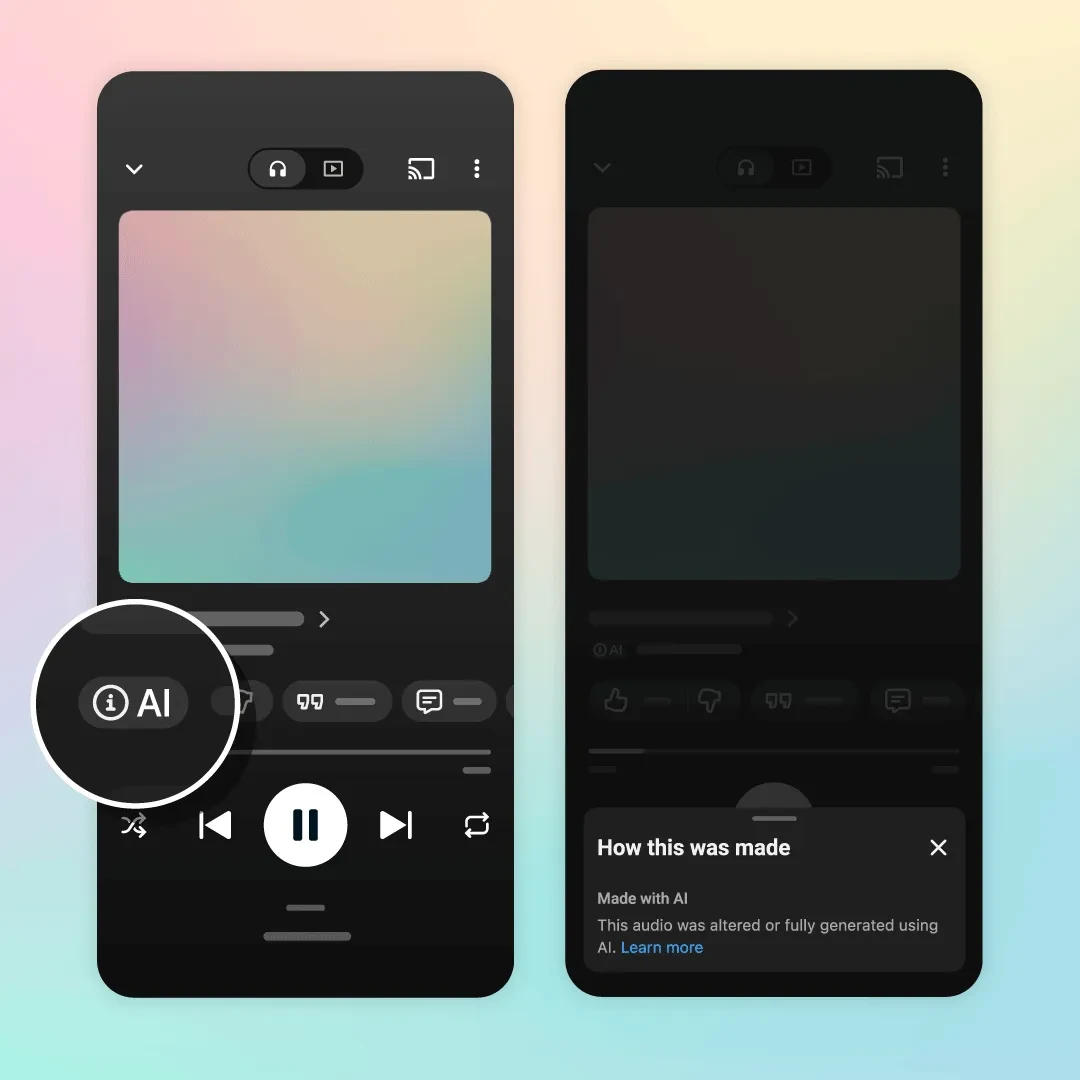
YouTube Music has joined the growing group of platforms making it clearer to listeners that they might be streaming AI-generated music. On 14 October it began rolling out labels for songs created primarily with generative AI, with the main YouTube app to follow. This is a disclosure move, not an anti-AI crackdown. AI involvement alone doesn’t make a track ineligible for monetisation, and the platform has its own AI music creation tool, Dream Track.
Listener demand for transparency is driving the push. Streaming platform Deezer, with market research company Ipsos, surveyed 9,000 people and found that 97% could not tell AI songs from human-made ones, yet 80% wanted fully AI tracks clearly labelled. The volume is huge. Deezer said in April that it was receiving almost 75,000 AI tracks a day, making up around 44% of uploads. Apple Music told Billboard that more than a third of its monthly uploads are 100% AI, yet they account for under 0.5% of listening.
Platforms have answered in different ways. Some detect AI music themselves, some ask labels and distributors to declare it, and one has banned it outright. YouTube sits in the middle. Partners can declare a track as Fully Gen AI, Partly Gen AI or No Gen AI, and YouTube may use its own detection tools and other signals where creators don’t disclose. It has not published a full methodology for how each labelling decision is made.
Billboard India maps how platforms got here.
June 2025: Deezer launches the “world’s first AI tagging system”
Deezer had been running an AI detection tool since January 2025. In June it put that tool to use for listeners, labelling albums that contain fully AI-generated tracks. It also pulled those tracks out of algorithmic and editorial recommendations. The tool has been named in TIME’s list of the Best Inventions of 2026.
September 2025: Spotify takes on impersonation
Spotify followed with an impersonation policy, a spam filter, and support for an AI-disclosure standard – which goes beyond a yes-or-no tag. It lets credits show whether AI contributed vocals, instrumentation or post-production. Spotify said it had removed over 75 million spam tracks in the past year.
January 2026: Bandcamp bans AI music
Music distributor and community platform Bandcamp blanket-banned music generated wholly or in substantial part by AI. It doesn’t rely on automated detection – instead asking users to report suspected AI music for manual review, and reserves the right to remove tracks on suspicion.
March 2026: Apple Music introduces Transparency Tags
Apple chose self-declaration. Labels and distributors can tag AI use in artwork, tracks and compositions, and Apple has said the tags will become mandatory for new content. The catch is that it works on trust – if a tag is omitted, Apple assumes no AI was used.
April 2026: Spotify tests AI credits and verifies real artists
Spotify began testing AI tags in song credits, but shown only where an artist discloses through their label or distributor. On 30 April it also launched “Verified by Spotify”, a badge with a green checkmark for profiles confirmed to represent real, human artists. Spotify looks for a presence on and off the platform, such as concert dates, merchandise and linked social accounts, plus consistent listener activity. Profiles that primarily represent AI-generated artists aren’t eligible. The approach confirms the human rather than classifying the AI.
June 2026: Tidal cuts royalties
In a policy published on 29 June, music and video streaming service Tidal said it would not knowingly pay royalties on wholly AI-generated music. A listener-facing “AI” tag and removal of fraud-linked tracks followed on 15 July. Tidal said it would keep accepting AI music that meets its guidelines.
August 2026: Spotify adds an “AI Persona” badge
Artists could self-disclose an AI Persona from 11 August, with the badge appearing from mid-September. Spotify may also apply a “Likely AI Persona” label after review, which artists can appeal, and such profiles are excluded from recommendations by default. The badge is about the artist’s public identity, not how the music was made.
October 2026: Deezer adds an AI filter
A day before YouTube’s announcement, Deezer said users will be able to remove fully AI-generated music from their experience with a toggle.
October 2026: YouTube Music joins in
AI labels now appear on the player page, with more detail on AI’s role one tap away. Whether disclosure is enough for listeners will be tested as the labels reach the main YouTube app.