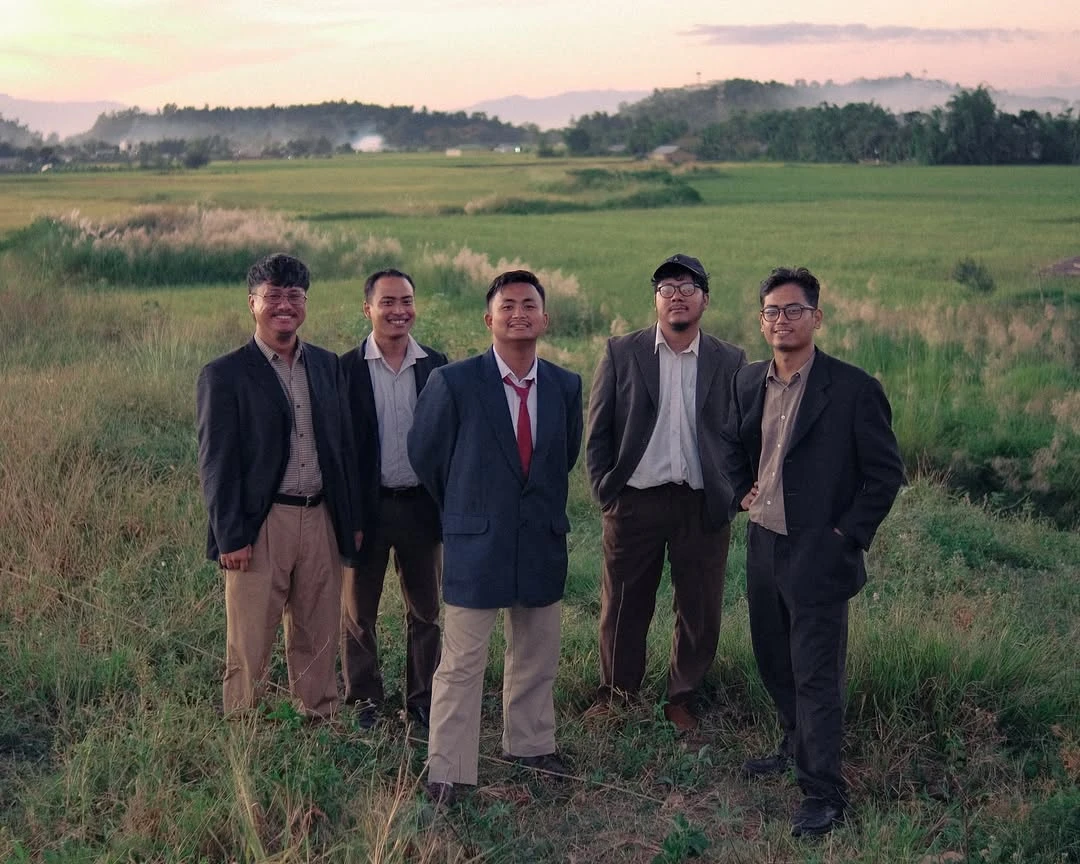
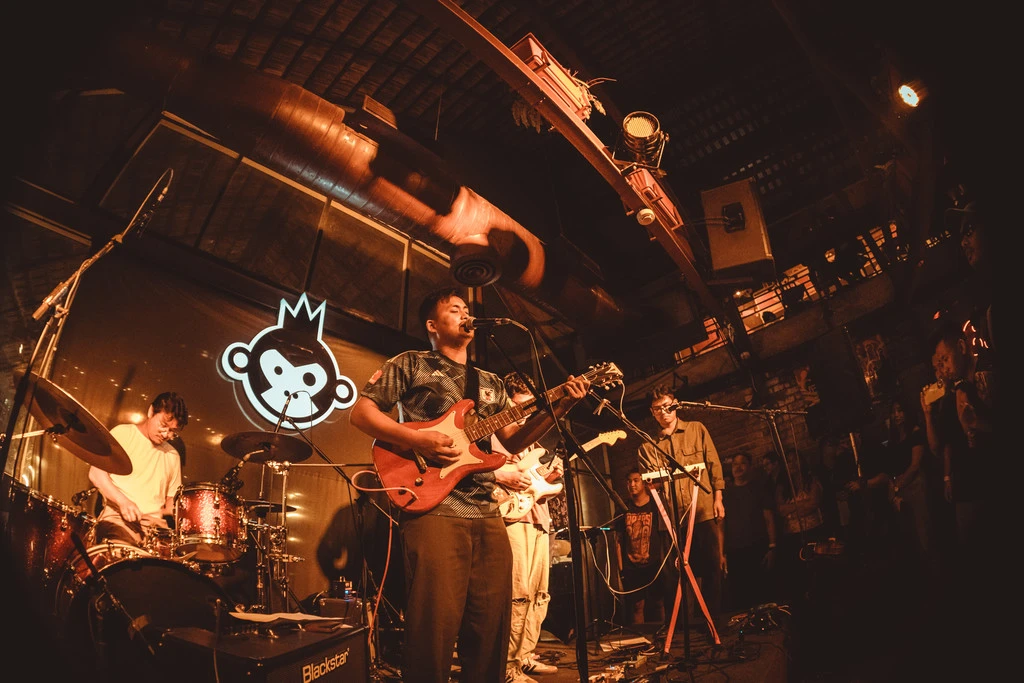
Meewakching is truly an anomaly – coming out of the small town of Imphal to make music that is international in scope. Imagine a band as lyrical as Arctic Monkeys, as rock and roll as Cage the Elephant, and as emotional as Arcade Fire, and you might find yourself describing Meewakching. They are also on the lineup for Lollapalooza India 2027.
Singing in both English and Manipuri, Meewakching blends melancholy shoegaze with angsty anthems against injustice. Their music has garnered more than 6 million streams on YouTube. Songs such as “Of Murder and Mayhem” and “Absolute Minority” from their third EP The Land gained repute for their politically charged songwriting, which confronts political violence in a manner that is urgent and defiant.
Their 2025 sophomore LP BILDUNGSROMAN refers to ‘coming of age’ in literature. “We never stopped. We never looked back… We ain’t young now. We’re slow and sad…” the lyrics to their track “Supermarket” from the album go. For a band which released their first EP in 2020, they seem to be coming of age now too.
The band comprises of Silheiba Ningombam (lead vocals and guitar), Dingku Sorokhaibam (guitar), Swami Laimayum (bass), Ronald Sorokhaibam (drums), Sanahal Phairenjam (violin and keyboards), and Ashish Adhikarimayum (backing vocals, guitar and percussion). Frontman Silheiba Ningombam speaks to Billboard India about how their music comes from their roots, the push for a global sound, and more.
What does Meewakching mean?
In Manipuri, Mee means Mortals and Wakching means Winter, but “Meewakching” is made up. It doesn’t have an already established literal meaning. But now it means “us”.
How do you navigate your identity as a Manipuri act?
We write from where we are, so Manipur inevitably becomes part of the music, through the language, the experiences, the sounds, the anxieties and even the way we see the world.
Some of our songs deal directly or indirectly with the realities around us: conflict, identity, and the general feeling of being a young person trying to make sense of all of it.
We don’t want every song to become a statement. Sometimes representing a place means showing its humour, beauty, contradictions and ordinary everyday life.
How is writing songs in Manipuri different from writing songs in English?
Manipuri comes very naturally when I’m trying to express something intimate while English gives me freedom because I grew up listening to it and I’ve absorbed the vocabulary through music and literature.
Meewakching’s Manipuri songs have an especially strong appeal among your audience. Why do you think they respond so strongly?
I think language creates an immediate intimacy. When people hear something in the language they speak everyday, there is an instant recognition. They don’t just hear the melody; they recognise a phrase, a way of speaking, perhaps even a part of their own life.
How difficult is it to make music in the Northeast, and for it to get national spotlight?
It’s not easy to make a living purely through music in the Northeast. The difficult part is sustaining yourself and continuing to create in the circumstances we’re in.
There is enormous talent in the Northeast, but the infrastructure connecting artists to the larger national music industry hasn’t been strong. Touring is more expensive, industry networks are concentrated elsewhere, and opportunities for regular exposure can be harder to access. There are fewer opportunities, fewer venues and, compared to the bigger cities, not as much infrastructure around music.
But when it comes to actually gaining national or even international attention, I honestly don’t think it’s as difficult as people might assume. If you’re committed, you keep making music, and you make music that can connect with people beyond your immediate region, I think there are opportunities.
For us, we’ve never really wanted to make music that is only seen through a “regional” lens. We’re from Manipur, and that naturally becomes part of who we are, but we’ve always wanted to sound as global as possible.
What are your favourite cities to play in?
Every city has a different energy, but Bengaluru has always been special to us. There’s a very active independent music community there, and the audiences are incredibly receptive.
Some of our most meaningful shows have been in Manipur. There’s something very different about playing to people who understand the language, references and emotions in the songs.
You’re on the Lollapalooza lineup alongside artists like Fontaines D.C. What does that feel like?
I’ve followed and admired Fontaines D.C. since 2018 through a KEXP performance. I admire that they’ve managed to become a global band without losing the character and identity of where they come from.
Seeing our name on the same Lollapalooza lineup is something I don’t think we would have imagined when we started Meewakching. It means a lot because we’re coming from a place where simply continuing to make music has sometimes required a lot of resilience.