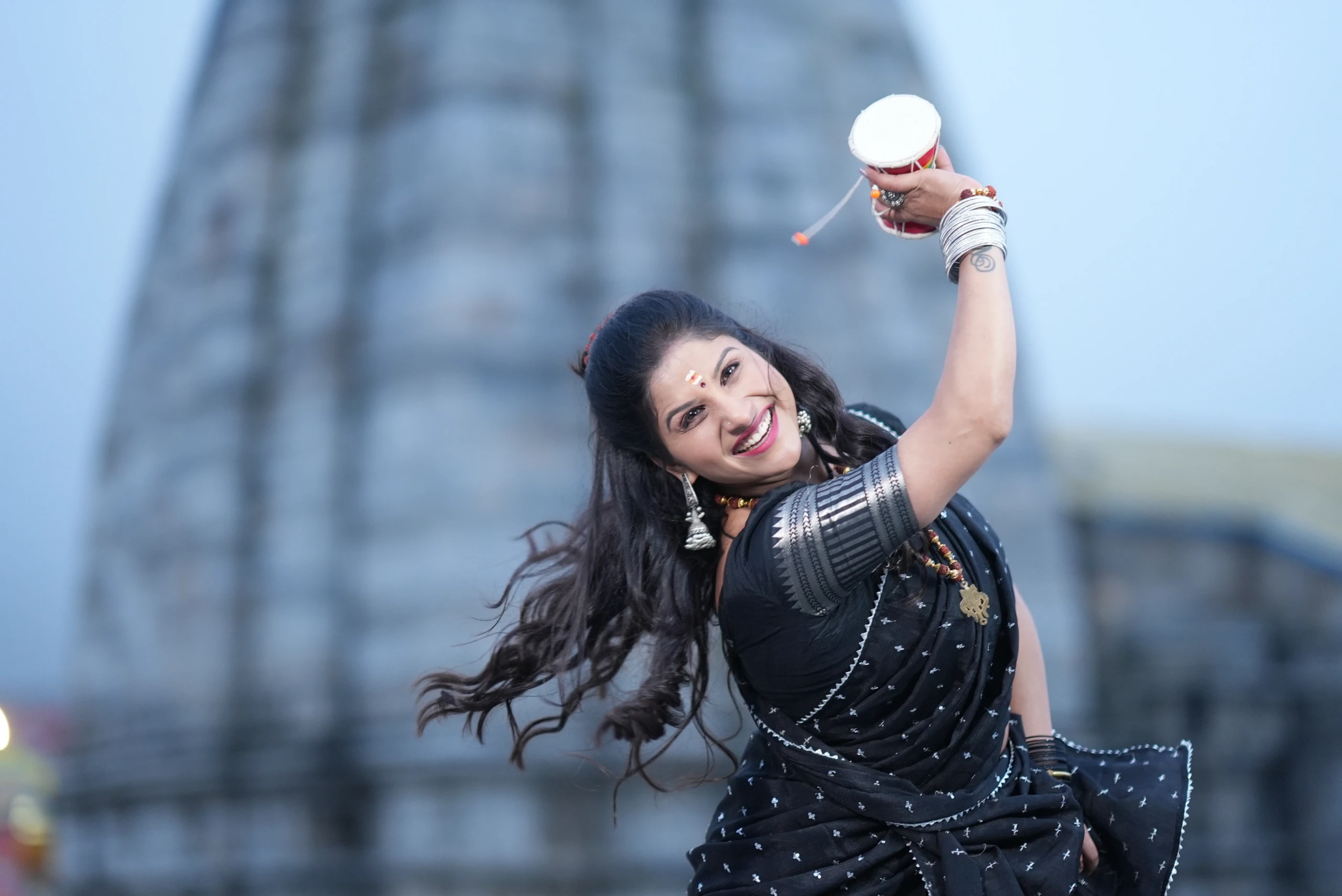
It’s hard to believe that music videos made on small budgets of just a few lakhs in a small town in South India can garner hundreds of millions of views on YouTube. That’s what Mangli has done with her music. A folk artist from Telangana, Satyavathi Chauhan has been releasing her videos on YouTube since 2017 with her screen name Mangli. Her videos focus strongly on festive and devotional themes, telling stories of Telangana culture with groovy beats.
Mangli’s journey in music was not backed by a label, but self-funded. Her tracks like “Aada Nemali” and “Ravuthalli Ravuthalli Renukellamma” have clocked 368 million and 98 million views, respectively on YouTube. She is now a recognisable name in Telugu film music too, but continues to fight to keep her music fiercely independent. For her, keeping “the soul” of the music alive is very important. Her hit film songs include “Ramuloo Ramulaa” from Ala Vaikunthapurramuloo with 795 million views, “Saranga Dariya” from Love Story with 195 million views, and “Bhoom Bhaddhal” from Krack with 111 million views.
Mangli is part of a growing movement of Telangana folk singers whose massive traction on YouTube has led to mainstream success. Most recently the “Yeshanagula” song by Anirudh Ravichander from The Paradise movie is an adaptation of the folk song “Yeshanagula Kattameda,” a traditional Telangana number originally sung by folk artists Jangi Reddy and Prabha Bangarigalla.
Billboard India sat down with Mangli to talk about her journey, the push for indie songs, how YouTube democratised the industry, and why she believes Telangana folk music is built on authenticity.
Why did you put “Rela Re Rela Re” out yourself in 2017 rather than going through a label or waiting for a film break?
I didn’t want to wait for a label or a film, and I didn’t go the reality-show route either. I come from a Carnatic music background, so I was always clear that I wanted to build my career independently. Growing up, we listened to a lot of folk and independent music from other languages — artists like Falguni Pathak and Daler Mehndi built entire movements outside of film music, and that showed me how powerful independent music could really be. It made me ask: why shouldn’t Telangana folk globalise the same way? Why can’t we reach those same heights? YouTube gave me that stage. There’s a real autonomy to it — you’re not bending to rules or begging anyone for opportunities. If you’re talented, you can simply perform, and that’s the kind of platform YouTube is. That freedom mattered more to me than timing ever did.
You’ve said before that song is the one that “made you the artist.” What did it change for you?
New doors really opened for me. My name started to grow, shows increased, and people in the industry began to recognise me in a different way. But more than anything, what I gained was love and respect, and that’s what has mattered most to me through all of it.
You built 50-plus independent singles alongside a full film playback career. Why keep releasing independently even after the mainstream doors opened?
Even after films came in, indie still gave me the freedom to try sounds and stories that feel personal to me. It keeps me grounded, keeps me connected to my core audience, and honestly, it reminds me why I started making music in the first place.
Has anyone approached you to package or “develop” your sound for a bigger platform?
For me, independence brings peace and control, and I trust my own team enough to lean into that. That space is what lets me experiment. I’ve had big offers with money and perks attached, but at the end of the day, my own satisfaction — and giving my fans something true — matters more to me than any of that.
As folk sounds get picked up by film and mainstream labels, who do you think should hold the credit and the money?
The original artist should always get proper credit and a fair share, full stop. If someone else builds on that work afterward, they should acknowledge and compensate the artist who created and shaped it in the first place.
Is there a mainstream success for Telangana folk you’d actually want — versus one you’d resist?
I’d love to see Telangana folk go mainstream without losing its soul in the process. Success is great, but I’d resist anything that dilutes the authenticity or disconnects the music from its roots.
What’s the gap between producing an original song versus a film song?
The gap is significant. Our independent songs usually cost a few lakhs, while a comparable film song can cost many times that, especially once you factor in bigger sets, star casting and larger crews. That’s really the advantage of keeping things lean and independent.
What do you think you got right that big-budget songs often miss?
I think we got the authenticity right. We kept it simple, rooted and genuinely connected to the audience. Sometimes that emotional connection matters more than a big budget ever could.
Is YouTube itself self-sustaining, or is it really the reach that then converts into shows and brand work?
YouTube does bring in revenue, but for me, the bigger value is the reach — that reach is what leads to more shows, bookings and opportunities down the line. So it’s both, but the reach is really what drives everything else. I’m not doing this for the money, if I’m honest. I want people to love and respect the work. A lot of artists here take inspiration from Western icons like Taylor Swift, Adele and Michael Jackson, and there’s nothing wrong with that — but I keep asking myself, why shouldn’t we put that same energy into furthering our own culture? That’s really the reason I do YouTube.
For folk singers without your reach or your TV background — is YouTube alone enough to make a living, or does almost everyone still need stage shows?
YouTube helps a great deal, but I think stage shows are still very important for folk singers. Live performances give you a more direct and sustainable source of income, while YouTube is what helps build the audience and reach in the first place.
Who is your online audience?
It’s definitely not limited to Telangana anymore. We’re seeing a strong urban Telugu audience alongside a growing diaspora audience. The response from the US, the Middle East, Europe and elsewhere has made that very clear to me.
Does the audience shift by song — do the party/DJ tracks travel further outside the region than the more rooted, festival-specific ones?
Yes, definitely. The party and DJ tracks tend to travel further because they’re more universal — they work anywhere. The festival-specific songs are more rooted, and they connect especially strongly with the Telugu community across the globe.
If you had to choose one song of yours to cross a billion views, which song would you choose and why?
I’d choose “Dangaru Dangaru.” It’s a dance track with a spiritual heart. We shot it in Kedarnath, which was physically tough but spiritually powerful, and it connected with audiences instantly. It makes you dance and remember the divine at the same time, and that balance means a lot to me.