
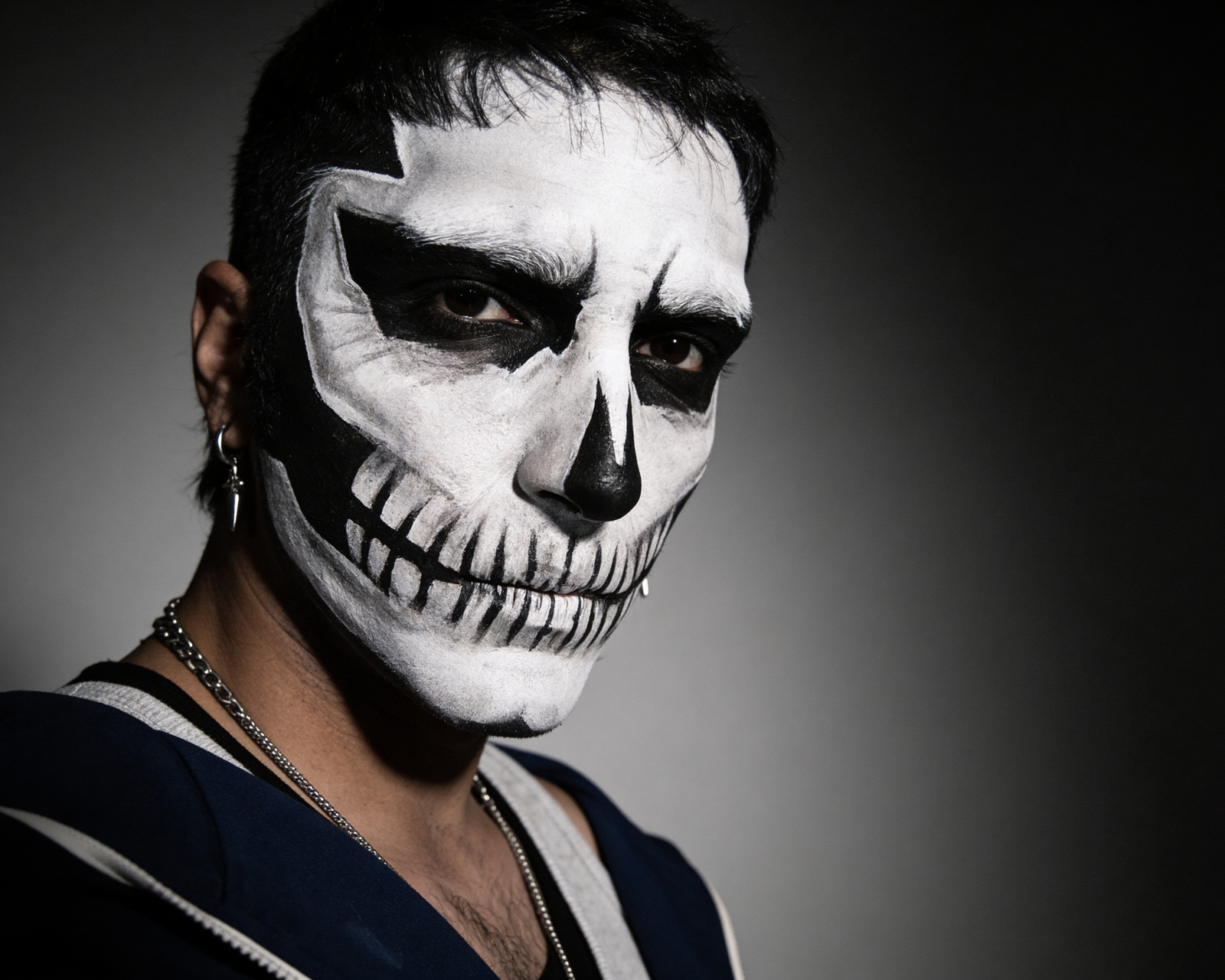
28-year-old Punjabi musician and producer Talwiinder, who is known for his painted skull face, has built a visual identity that’s as disruptive as his sound. It’s not only a signature look, it functions as an alter ego. While the base remains consistent, he introduces variations through metal studs, spikes, and flashes of colour. Talwiinder says his face paint helps create a boundary against his otherwise private personality. “When I’m in the face paint, come talk to me, bother me. But when I’m not in the face paint, just leave me alone,” he told The Hollywood Reporter India, earlier this year.
So what goes into constructing a look that feels both theatrical and precise? We speak to two of his regular collaborators—London-based makeup artist Roseanna Velin and New York–based makeup artist Ayman Syed—who break down the craft, intent, and layered meaning behind Talwiinder’s persona.
Anonymity as a visual language
“It’s about working against the face rather than with it,” says Velin who has collaborated with the artist on a few occasions, including his London show and most recently for the premiere of Riz Ahmed’s Amazon Prime show Bait. “The monochrome black-and-white flattens everything into a mask, and then shadows are used to construct entirely new contours. You’re not enhancing features—you’re creating an illusion over them. At some point, you stop seeing a person and start seeing something else entirely, open to interpretation.”
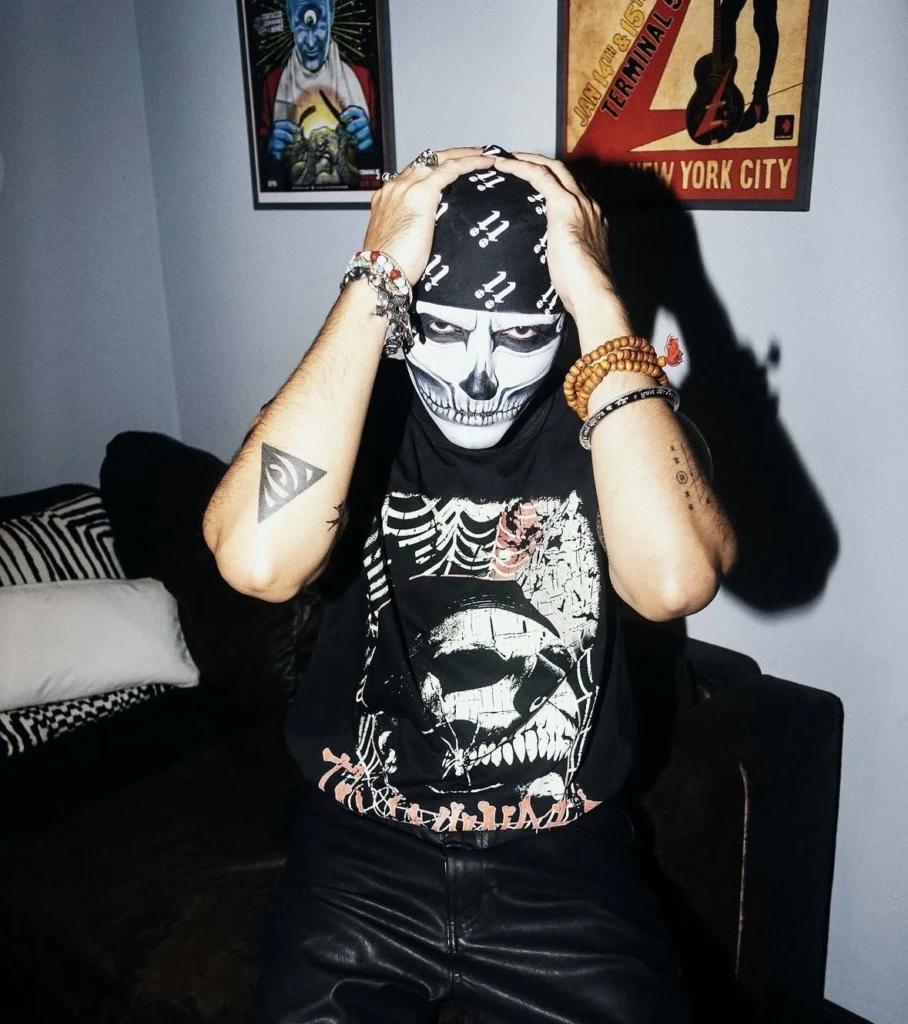
Fans now show up to gigs in their own versions of the now-signature skull makeup. Syed isn’t a stranger to South Asian faces, having worked extensively in defining comedian Alok V Menon’s beauty looks. For Talwiinder’s make-up she emphasises about how theatricality is the point, “It’s rooted in his identity as a misfit,” she explains. “From drawing on his own face early on to embracing something that’s still unconventional for a Punjabi cis-het man, there’s intent behind it.” The skull itself—universally tied to mortality and equality—anchors the visual, while also nodding to traditions of masked performance across cultures, from China to South India. On stage, the paint becomes an alter ego; off it, a language. “As a makeup artist, it’s exciting to take what he’s created and push it somewhere new,” she adds.
From base to stage
The run-up to achieve the final signature look ranges between 1.5-3 hours depending on the mood or the occasion. “I begin by mapping out the structure of the skull – placing key shapes, sketching proportions and checking for symmetry. From there, I build intensity, layering paint & pigment. I then refine edges, sharpen up lines and then add the shadows, followed by any last details or embellishments. There’s a rhythm to it, and it’s beautiful to paint along to music,” shares Velin.
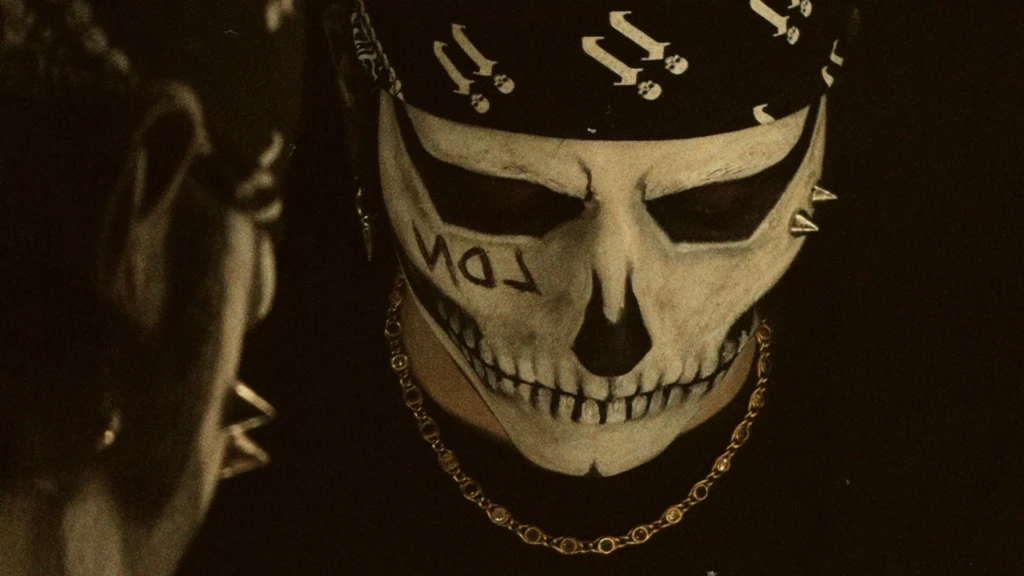
For a look that needs to brave sweat, heat and the demands of stage lighting, a strong base is essential. Syed emphasises the importance of heavy moisturising, allowing the paint to settle into the skin before sealing it with setting powder and spray.
Velin also finds beauty in imperfection. “A look with a lived-in texture can be just as compelling,” she says, referencing the video for Sachay Loki with Meesha Shafi, shot in the desert—where windswept hair and worn-in makeup added a raw, textural edge.

More than just a look
For Velin, working with Talwiinder has become almost meditative. “When I’m painting him, there’s a calm, patient rhythm to it—a process of transformation that feels almost ceremonial,” she says. “It’s sacred in a way. Painting someone’s face requires a great deal of trust and respect between artist and subject—the energy has to be right.”
The anonymity created by the painted mask does more than add drama; it alters the audience’s experience. “It redirects attention entirely,” says Syed. “At that moment, the focus is solely on the music.”
With the face painted the idea of celebrity begins to dissolve. What remains is something more accessible. For younger audiences in particular—those navigating identity, alienation, and the desire to belong—the look becomes a point of connection. “His music speaks to them,” Syed adds, “but the makeup becomes just as powerful a medium in expressing that feeling.”